

Turn a displayed price into a usable budget

How much would insurance cost for your cat?

A starting price, your offered premium and the amount you could owe after treatment answer different cost questions.

Two cats sitting together near a window at home
✓ Policy-first ✓ Independent ✓ Useful checks
Direct answer
Cat pet-insurance pricing depends on your cat, residence and selected cover. There is no verified universal monthly amount for your cat in this guide. Obtain the actual premium, separate any routine-care option and billing charges, and then test what you would retain on an eligible veterinary bill. A marketing starting price is not a personalized quote.
What to know

Read the footnote under the small monthly number

Spot’s official site illustrates the issue clearly: its advertised cat starting-price footnote names a particular age, mixed-cat profile, ZIP code, deductible, reimbursement percentage and annual limit. That narrow configuration is not a rate for every cat. This guide does not reproduce that headline as a current personal estimate.

When a result changes after entering your cat’s details, compare the assumptions before concluding that the price was an error. The provider may now be pricing a different age, location or level of cover. Keep the original advertisement only as a record of what it said, not as the amount you can budget.

Look for whether the displayed amount is a medical premium alone or includes optional routine benefits. A price attached to accident-only cover cannot answer what accident-and-illness insurance costs without making that narrower scope explicit.

What to know

Find the amount you are committing to pay

Amount Where to find it How to use it
Base medical premium Final quote with the chosen medical settings Your recurring price for the selected risk protection.
Optional additions Separate option lines or quote breakdown Decide whether each benefit is wanted before adding it to the total.
Routine-care package Preventive schedule and extra price Compare its cost with the services you realistically plan to use.
Billing or payment charges Checkout and payment schedule Use the actual total due, not only a rounded monthly display.

If you pay monthly, add the scheduled payments for the policy period. If you pay annually, use the quoted annual total instead of assuming it is exactly twelve times a promotional monthly figure. Record whether the next renewal can change the price; ASPCA Pet Health Insurance, for example, explains that age can affect renewal premium.

These steps estimate the insurance commitment, not the cat’s full care budget. Food, ordinary preventive care outside a selected benefit and expenses excluded by the medical policy can remain separate obligations.
Coverage

A cat bill can contain both eligible and excluded charges

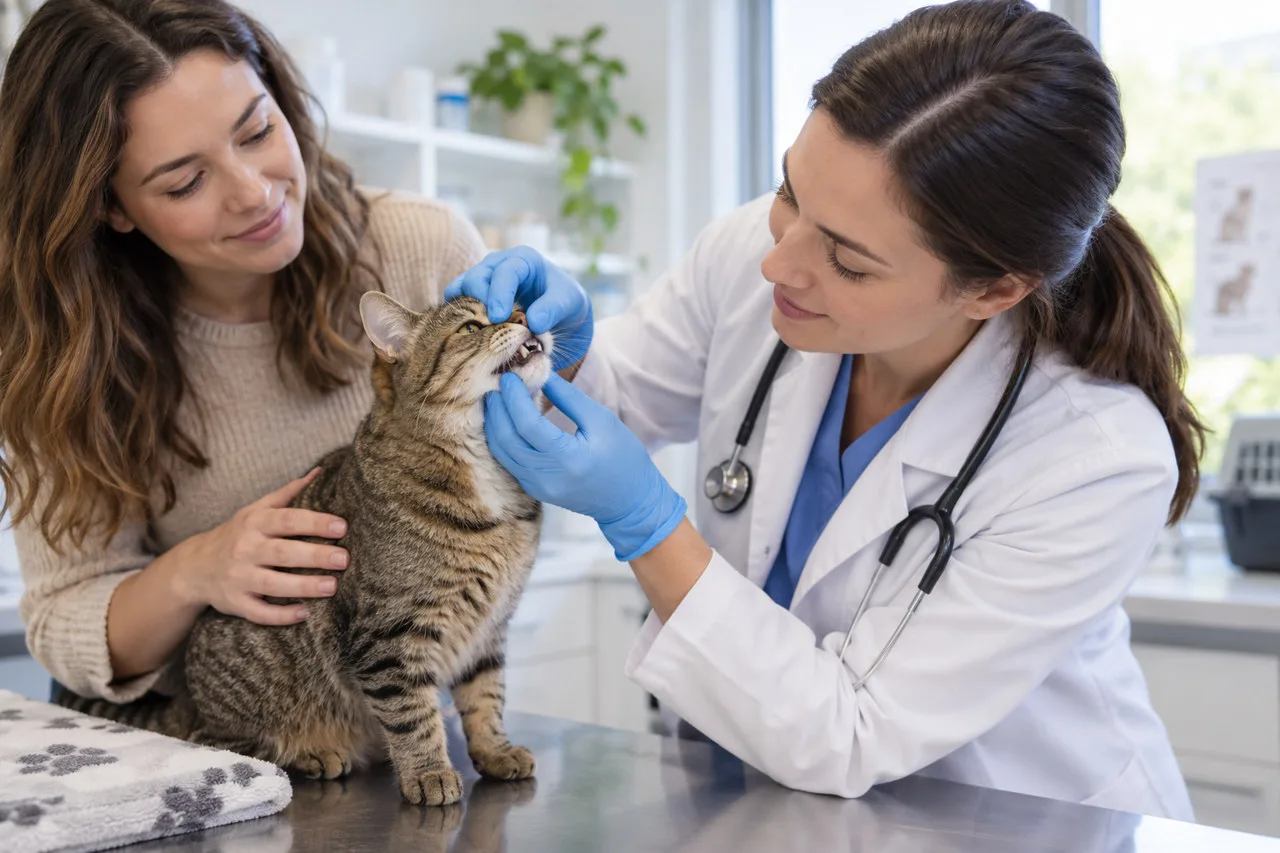
Veterinarian examining a cat with its owner nearby
The premium is one cost; what you retain when care is needed is another.

Here is fictional arithmetic, not a quote or an insurer’s payment promise. Assume a $980 invoice includes an $80 examination fee that the selected contract excludes. The remaining $900 is fully eligible, there is $200 of annual deductible still to meet, the policy pays 80% after that deductible, and no limit interferes.

The calculation is ($900 − $200) × 80% = $560. The owner retains $420 of the original bill: the $80 excluded fee, the $200 deductible and $140 coinsurance. Premiums are additional. If the examination fee is eligible under a different contract, or its formula orders the deductible differently, the result changes.

This is why “80% back” is not necessarily 80% of the clinic’s total. Fetch describes included sick-visit exam fees; other offers may structure fees differently. Compare the exact eligible-cost definition before using a reimbursement percentage as your cost estimate.

Decision guide

Which inputs belong to the cat, and which can you choose?

Age, breed and location are among the factors providers use in pricing. Enter those facts accurately. Changing a birthday or address to obtain a smaller number creates an unreliable comparison.

Coverage settings are different: you may be offered deductible, reimbursement and limit choices. Keep a record of which option moved the premium and what new owner responsibility it introduced. If a choice is not offered for your cat, do not substitute a setting from someone else’s quote.

You can finish with three useful figures: the insurance payment you can sustain, the care reserve you can actually access and the owner share under one clearly stated claim scenario. A national average would not replace any of them. Recheck the same figures at renewal rather than assuming the first offer is a lifetime price.

Evidence

Sources and policy context

These public references support the consumer or veterinary context. Named insurer details were checked in official product materials; the policy offered for your pet and state determines the actual terms.

Next step

Compare Current Pet Insurance Rates

Check current options for your pet and location, then compare the policy details, exclusions, costs, and eligibility before choosing.

Compare the policy before you choose Check the actual offer, exclusions and out-of-pocket terms.
See Rate Options